

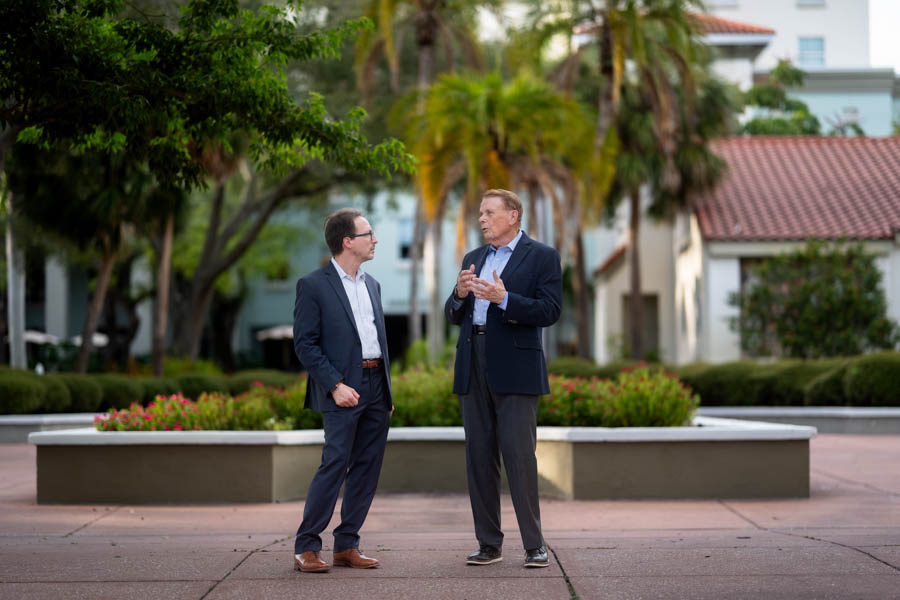
As one era ends, another is set to begin. On January 23, the Ringling College of Art and Design announced that Davis Schneiderman, Ph.D., would become the institution’s seventh president. Dr. Schneiderman came to Ringling from Lake Forest College, a nationally-ranked private liberal arts college in Lake Forest, Illinois, where he served in senior leadership for 10 years, including as Provost and Dean of Faculty from 2018 to 2023. Dr. Schneiderman, who assumed office on June 1, represents Ringling College in its current identity as one of the top art and design colleges in the world. He brings a background forged in higher education, working at the nexus of interdisciplinary innovation, artificial intelligence and technology ethics in creative education. What Ringling College intends to build upon, in appointing Dr. Schneiderman, is the legacy created during former president Dr. Larry R. Thompson’s 27-year tenure. Under Dr. Thompson, Ringling College went from a minute, yet locally revered arts school, to an internationally recognized college of art and design. Moreover, Ringling College became in itself an attractor to Sarasota—from its heralded academic programs to professional opportunities to economic drivers, such as the Sarasota Art Museum. SRQ Magazine sat down with Dr. Schneiderman and Dr. Thompson to gauge their perspectives on what Ringling College means to them, its place in the Sarasota community and how to set the institution up for another century of success.
SRQ: Dr. Thompson, in a tenure that saw you grow Ringling College from a small arts school to an internationally recognized institution, what are you most proud of? DR. LARRY R. THOMPSON There are so many things, but to witness the college becoming what it was meant to be—that's probably the biggest accomplishment, and that involves a lot of different areas. Our vision is to become the preeminent art and design college in the world, and that vision is becoming a real reality. Before when people talked about Ringling College, they would say, “Is that like The Ringling Museum?”, they would have no idea what it was, but now they all know it. It has become one of the very top art and design colleges in the world.
What was it about Ringling College that made you believe in it as an agent for change in Sarasota? DR. THOMPSON It was after I’d been here for a few years. One of the things that I kept thinking about was that this was an institution with these really passionate students, and the faculty were passionate about what they did, and so what dawned on me is that I know from my past experience as a leader, I'm going to have to raise a lot of money. For the college, the president's big job is raising money, and I thought, how am I going to do that? Almost all colleges raise money from their alumni. At that time we didn't have very many wealthy alumni—they had jobs working within the entertainment industry and such, but not the kind of money that you needed to make a big difference. I then looked to the community, and tried to think of how I can make this college the thing that everybody wants to pour themselves into? So that the Sarasota community thought of themselves as affiliated with the college, which was a whole other fundraising strategy from the way most colleges operate.
How did you go about doing that? DR. THOMPSON By finding ways to have the community connect with the students and with what was happening here. I did so many tours of the college at that time, I’d take these people from the community and show them what we did and how it was different from most colleges that they were probably familiar with.
Under your tenure, Ringling College embraced the idea of “the computer being the next paintbrush.” What did that mean for the college then, and what does it mean now in 2026? DR. THOMPSON We were the early adopters of technology. The animation program was here when I came. It was in a dingy, ugly building, but regardless, we were at the forefront of the computer becoming the next paintbrush and that’s exactly what has happened. Now it's all digital. We still have the fine arts and painting and the other disciplines—you’ve got to have that ability. There’s a reason why you primarily take classes in art making in your first year. However, it’s all about using that then when you're going to go into any field that involves the computer. It’s similar with AI—AI is the kind of thing that many people are afraid of. There were people back in the day who were afraid of computers taking away their jobs in respect to being artists and that’s the big concern that artists have in general with AI. Our own students are also very concerned about the use of it. Things change over time, and you have to be out in front of it. Now, we're one of the colleges that's at the forefront of what's happening with AI. We’re not doing it in huge steps, but in a very measured sense, because we know that students are going to have to be able to use it in their future careers.
Dr. Schneiderman, at Lake Forest College, you worked and taught at the nexus of Artificial Intelligence and education. How do you see the role of AI evolving in creative education at Ringling College? DR. DAVIS SCHNEIDERMAN It's a fraught issue, it is controversial. You don't have to read very many headlines to see the backlash to data centers, so there are real environmental questions. But when people talk about artificial intelligence, are they talking about ChatGPT, are they talking about their GPS? Are they talking about facial recognition technology? The word AI means many different things like the word love means many different things. So I start by disaggregating, and I don't think all AI is bad or all AI is good because those are extreme positions that don't separate what you're actually talking about.
For some creative professions, like our graphic design folks, they may be using AI to help iterate and design concepts, not to do the work itself. Computer animators are rightfully more skeptical because they don't want to prompt a movie into existence. They want to make a movie into an existence. I don't think there is one answer. I think the answer is very domain-specific, and I always say to students: if you want to hate it, you should learn how to hate it more effectively, and if you want to use it, you should learn how to use it more ethically. It is not a one-size-fits-all, and as the social norms around it change over time, an agile artistic mind can help change with those times. You have to decide if you're using the technology or if the technology is using you. However, there are ways to come up with frameworks of use. Our faculty member and AI Coordinator, Rick Dakan has contributed in large to developing the 4D fluency framework and has been in partnership with Anthropic and other places to help us figure out how to be ethical users and critical users of a technology that is not going anywhere.
How has the definition of a successful art and design education changed since you first entered academia? How is it defined at Ringling College? DR. SCHNEIDERMAN The history of art and design colleges is like a completely fascinating topic that goes back hundreds of years. Even the programs that Ringling College had in 1931 are not the same programs that we have today. There was no computer animation back in the 1930s. So one of the things that an art and design school needs to do is to be true to what motivated and animated its founding, while being unafraid to be agile and adaptable to new technologies, whether that's artificial intelligence or other things of that nature. If you have no past, you have no future. And if you only live in the past, you also have no future. Understanding where we came from and thinking about what's important to us is the best way to go forward. For artists who come here, often they have the passion. We can help fan the flames of that passion, but by the time they get to us, they're people who know what they want to do. We need to make sure that they come out as professionals. We take your artistic passion and teach you how to make a living with it in the world.
What do you see as Ringling College’s greatest opportunity over the next decade? DR. SCHNEIDERMAN Ringling College is in year 95, and that's an astounding legacy to build upon. So much of our success in so many different areas comes from all the people who've contributed to that legacy. I think that Dr. Thompson's vision for Ringling College to be the preeminent art and design college in the world is within reach. We have a national and an international reputation, and I believe that my job as president is to build upon that momentum and to extend it. There's always room to grow, however. In an increasingly challenging college environment, there are fewer college-going students nationally now than there had been in the past because of the students who weren't born after the 2008 financial crisis. There's a demographic cliff, a birth dearth, so to speak.
All colleges are looking to make sure that they can find the students who are best suited, and one of the things I love about Ringling is that it's got a point of view, it's got a perspective. It's not a college that is all things to all people. If you come here, you are working and operating within this band of art and design, and so we want to find you and we want to bring you here. We have to help students and families understand "why Ringling" compared to one of our competitors. There are competitor schools, but I think if we were you know to go outside and fight in the parking lot at 3pm, Ringling would win, and I want to make sure people know that.
In your tenure as President, what will be the hallmarks of your leadership style? DR. SCHNEIDERMAN I think of colleges as a collective enterprise. I'm not, by nature, a top-down person. I'm a consensus builder, and I seek to find what makes people proud to be here, and to help them grow that pride in the work that we do together. When I'm trying to help determine new directions with the people who work here, it is far from a CEO in a boardroom, it is more like a mayor and a council form of government, where you spend a lot of time talking to people and working with them and understanding where they're coming from, what's important to them and then you come up with decisions that have collective buy-in. Because that’s also how people make art. There's a myth that artists operate alone in a silo, as if in a garret painting, but every painting is the story of how the painting was made. Every book is the story of how the book was made. Lots of people are involved in making a book: printers, publishers, editors, agents. Even if you think well, none of us were born knowing how to paint or knowing how to write, we all learn from other people. So even the solitary myth of the artist is not entirely true. We make art in a community environment, and Ringling College is a strong community.
Do you see opportunities for fostering deeper collaboration between Ringling College, local businesses and arts organizations? DR. SCHNEIDERMAN There are a lot of ways that Ringling students work with the community through our INDEX (Industry Experience) program, which is a way businesses or nonprofits can approach the college to ask for student expertise in their own design projects. Our students have worked at many places: IMG Academy, Planned Parenthood, Art Ovation, the Orioles, Sarasota Police Department, Sarasota African American Cultural Coalition, Smithsonian American Art Museum, the Moffitt Cancer Center, General Motors—not as employees, but they've contributed in some way. We have students doing internships at Disney. This is separate from all the students who then go on to work for big movie studios—of Oscar-nominated films this year, 66 Ringling alums were involved. The media that is produced to help Americans enjoy art is made in part by Ringling alums, Ringling Grants. We exist in the Sarasota ecosystem, and do all of those things I just mentioned, and then we bubble out into the larger entertainment industry.
Dr. Thompson, what are you going to miss about being at Ringling College everyday? DR. THOMPSON I'm still in that transition stage. I miss it a lot, because it’s 27 years of solving one problem and then the next, and I’ve had an incredible board of trustees that I’ve worked with. That’s one of the elements of nonprofits, you have a board of trustees that’s usually pretty large and you have to be certain that you get the right people involved. People who are passionate about the institution. So I do miss the excitement, but I’m 78 years old and knew that it was time to retire. I thought that Ringling College may need some new energy and new direction for the future, so while I’m sad about leaving, I’m also happy because I believe that the board selected a great candidate to be the president. SRQ